

Starting A Manufacturing Business

No joke, how many emails back and forth are you getting with your suppliers? 2-3 a night max? And only if you’re working late, probably just 1 response realistically. Whether you're bootstrapping or scaling to production volumes a platform allowing you to chat directly with them, with integrated part visualization for detailed questions and DFM is a game changer.
This is a new series of articles on what we’ve learned starting a manufacturing business (and how you could do it too), and we think it’s some of the most compelling stuff we’ve written in the last 3 years. To make these articles possible, we would like to introduce the series sponsor, Jiga!
With all of our recent experiences in supply chain, they are extremely pertinent to the discussion of how manufacturing and procurement can and should be done.
Engineers and supply chain managers spend way too much time on sourcing. They email suppliers, wait days (if not weeks) for quotes, chase updates, manage spreadsheets, and deal with miscommunication across time zones. It’s slow, frustrating, and pulls them away from actual engineering work.
Jiga fixes that. They connect engineers directly with vetted manufacturers of CNC, 3D printed, and injection molded parts, handle quoting and communication in one place, and give full visibility into every order. What used to take weeks now takes hours.
Intro
We believe there has never been a better time to start a manufacturing business!
Tensions with the industrial powerhouse China have never been higher (in recent history), VC have never cared so much about physical things, and AI and 3D printing give newcomers massive advantages relative to the incumbents.
Why
This website has up until now been purely dedicated to helping mechanical engineers get jobs. Coming out of school, Mechanical Engineers are some of the highest earners, especially now with the contraction in software engineering. That makes it an extremely compelling workforce to join. The median job pays $70–80k, with the high-paying entry-level jobs on the coasts offering as much as $120k+. However, a downside of the mechanical engineering profession is that there is not compounding growth in salary that you might see going into finance, business, law, or the medical field. It is crazy rare to find mechanical engineers who make more than $200k [base] a year in salary no matter their level of experience.
I think the easy way to look at this is through a quick example. Say you start at $100k and grow your salary to $200k over 20 years (3.5% per year). You would earn $2.87M and pay $1.15M in taxes (assuming you are in CA, which is reasonable given the salaries), leaving you with $1.72M in lifetime earnings. That seems quite good; however, when you factor in net present value and inflation (a 4% real discount rate is often used), that number aligns closer to $1.25M in today’s dollars of take-home.
While compared to the median earnings of college-educated Americans, this is a phenomenal return, mechanical engineers are generally a more ambitious bunch (you didn’t take those fluids and thermals classes just for fun) and this is frequently seen as a subpar return for so many years of specialized work.
To sweeten the pot there is another way to get more value: equity. While this has predominantly driven massive gains to software engineers, hardware engineers can also benefit by joining a unicorn early. The best examples are Tesla, SpaceX, and Nvidia, though given the recent surge in VC investment in hardware I am sure there will be a bunch more. The game to play here is to work at 3–7 hardware companies over those 20 years who are Series B to Series D (200–2,000 employees). You just need one or two of them to go to the moon to walk away a millionaire! The upside is clear here. The downside can be working in a very intense workplace that demands 60+ hour weeks for 2 decades while you potentially try to raise a family, get older, etc.
On the other side, one of my favorite stats is that most millionaires in America are small business owners.
This is where the opportunity for a hardware engineer to grow their wealth greater than through the typical W2 route takes shape.
It used to be that getting an MBA would be a good idea so you had a good business understanding before jumping in (or you could go back to the W2 in a management position with higher salary potential), but we would argue that ChatGPT is an omnipresent searchable MBA with personalization for your situation. Save the $200k and put it into your next endeavor!
Ok, so now when it comes to how to start/run this manufacturing business we see 3 options:
Raise venture to start a manufacturing business
Buy a manufacturing business with an SBA 7A loan
Start a manufacturing business from scratch(bootstrap)
1. Raise venture to start a manufacturing business
This is by far the easiest option. Change your LinkedIn profile to Stealth Startup and watch the VCs who are currently investing in all things Defense/Manufacturing (6 months ago it was crypto . . . lol . . .) pile into your DMs. Pitch a segment of manufacturing that has a $100B TAM (Total Addressable Market) and raise $2–5M seed money to start a factory. While there is the least amount of friction here, the most likely option unfortunately is not success. VCs make 100s of bets and they just need a couple to make it big and pay off all of those investments. You are making 1 bet . . . the risk is much higher to YOU. Furthermore, the best dozen funds (Sequoia, A16Z, Benchmark, etc.) see a massively disproportionate set of successful outcomes relative to everyone else and effectively prop up average returns. Those VCs in your DMs are most likely not the front of the pack. Like you, they are aiming to disrupt. This article is not about why VC-backed manufacturing companies as a cohort won’t be successful, but we think for risk-adjusted returns for any single mechanical engineer, this may not be the best return on time and effort.
2. Buy a manufacturing business with an SBA 7A loan
This option is quite interesting. There is a massive number of baby boomers who own manufacturing businesses and are retiring. Small banks will give you SBA 7A loans to buy these companies because of your degree. You have to be careful to pick the right one, but we generally think this has the highest chance of a successful outcome. The business might have 50 years of product-market fit. That list of customers, reputation, etc. is a fantastic foundation to build on. Also, MBAs who usually buy boomer businesses are scared of manufacturing because of the technical risk. That’s your bread and butter. This article is also not about this option so we won’t go too deep, but the gist of a 7A loan is that you personally guarantee it. That means if you run the business into the ground, the bank will unfortunately come for all your assets. While bankruptcy is a horrible thing, for most of our audience who is in their 20s on the coasts you probably don’t own a house or are married; therefore your assets aren’t very valuable in the scheme of things and you can just go get a W2 post-bankruptcy (note that this will impact future ability to get loans). This really confused me as there was asymmetric upside to younger borrowers. We asked a bunch of banks about it and since the loan is mostly backed by the government and they don’t want to prioritize based on assets there is no penalty to not owning a house or having a partner! Downside risk = mitigated. The upside benefit comes in what we think of as a multiple arbitrage. Imagine you grow a $5M revenue business into a $20M revenue business. Now you own a $20M revenue business (which is 4X bigger) and it will sell at a great multiple to PE (say 5–7X EBITDA instead of 2–3X). You basically can see an 8X outcome for 4X growth. One day we will dig into this further. We heavily considered going this route for a while and have a bunch of interesting data. Stay tuned. In the meantime, cherry-pick the manufacturing episodes of this podcast. It is quite dry, but so valuable.
3. Start a manufacturing business from scratch
We are basically going to talk about this option for the rest article, but we need to discuss a couple other things first.
The biggest tax loophole in America . . . QSBS . . .
The Qualified Small Business Stock exception is an incredible piece of legislation meant to help small business owners. It is even more beneficial than the classic real estate 1031 exchange (gains from your first real estate sale can go into your next real estate purchase tax-free).
We are not CPAs so we recommend you talk to your own tax advisors, but the gist is that if you buy or start a business and hold onto the stock for 5+ years, the first $30M (Trump just increased this from $10M) of gains (full sale price if you start from scratch, or increase in basis if you bought the company) is distributed tax-free on a federal level (CA still charges tax 😟 womp womp). Oh, and by the way, this is per shareholder so if you start it with 2 friends you can each do this up to $30M. Plus, as of July 2025, if you sell after year 3 it is 50% of gains or 75% of gains in year 4. There are 3 things to know:
You have to file an 83(b), sign it and send it in the first 30 days after creating the company.
You have to sell in a stock sale, not an asset sale. This means you sell the assets and liabilities, which can be more challenging than just the assets and may have fewer buyers. Granted, you may also be willing to accept a slightly lower price if you aren’t paying federal tax via a stock sale than a similar business would on asset sale.
You need to be a C corp for this to work. There seems to be a lot of minutiae on why someone might choose a C corp vs an S corp for their business, but we usually try to examine things from a perspective of symmetry. The way we see it, there is some upside to potentially slightly lower taxes in the short term with an S corp (disadvantages non-withstanding). They are essentially taxed as pass through entities similar to LLCs. However, the upside is completely asymmetric with C corps due to QSBS sales exceptions. Time will tell if this tactic will pay off, but our philosophy is to optimize for what moves the needle. 5% doesn’t, 50% might.
Starting a small manufacturing business from scratch!
Okay, here we go. Buckle up and get ready.
We are kicking off a new era of Hardware is Hard focused on starting a manufacturing business in America, because we quit our jobs 6 months ago to do this and it is fresh on our minds.
Starting a business from scratch, especially one you bankroll, is exceptionally risky. Hardware takes time to build and even longer to reach product-market fit. One of my favorite non-VC hardware company start from scratch is Opulo; they have grown their pick-and-place business from a garage to a massive entity and documented it along the way. Check it out!
This is why we believe that starting from scratch for a product is a bad idea. Or, perhaps not a bad idea, but a risky one. Instead, go into a business where product market is almost guaranteed. As we mentioned earlier there is a ridiculous amount of VC money pouring into hardware companies. Most of them are building hardware products (even though they want you to believe they are building AI software products…). The American industrial supply base can’t move as fast as these companies need. The great subcomponent manufacturers (maybe even the one you buy with a 7A loan) have been putting away cash for decades making the same things since the 80s. They are extremely averse to growth or risk, especially since they are about to retire. Why open a new facility to meet higher demand when you just want to work 3 days a week and go sailing on your boat? Find a startup you believe is gonna win (under 100 employees). Find a supply chain gap, and go all in delivering that thing as quickly as possible. Sell yourself as a product and a service (you are an engineer). Why target small, quickly growing companies? Rising tides lift all boats, and if you can supply them, as they gain traction you will to. Also, it is WAY easier to get in the door and be taken seriously at smaller companies. A bigger company may have layers of defenses (bureaucrats) and it will not only take longer, but potentially be unjustifiable for them to trust you with a critical business need. Their risk tolerance is much lower than smaller companies. Another layer of defense is that you may actually be able to physically show up on-site randomly and meet with someone at a smaller company who will discuss their problem with you. Walking in the front door does wonders relative to DMing.
For the product vertical that you choose, it is also important to try to stay away from research projects. Research projects (i.e. not a solved problem) are great for defensibility, but have indefinite timeline and require undefined resource input. Stick to things that are solved problems, where integration can be tricky but not impossible. In this case, the goal is not to invent something completely novel (at least at first). It’s not as sexy, but the goal is to make something in the US, quickly and cost effectively, and to reach that goal, you cannot be putting all your chips on a science project.
Jumping In:
Depending on your risk appetite, there is a certain level of maturity you may desire before jumping in. That’s okay, you can do some stuff on your nights and weekends, but in this game, moving fast is big. If what you found is an underserved market and you are serious about starting a business, you will have no choice but to jump in and get moving. Any time you spend working nights and weekends is time that someone else is spending working days, nights and weekends.
That said, here are a few things it might be good to consider fleshing out prior to pulling the trigger:
Market evaluation / Location
Look at growing markets, find the most likely winners (look who is backed by the big VCs), and talk to them. Find their pain points, and see if there’s somewhere you can help address it. Move your location to wherever they are. Proximity is a powerful plus, and no one else is likely to pick up their existing business and do the same thing. You’ll be starting from scratch, and they will love working with you if they can see and trust you in person.
Technical feasibility
Make sure that whatever pain point you’re trying to address is something you can address, ideally with relatively low capital expenditure (at least at first), and ideally relatively quickly. I personally wouldn’t decide Silicon fabs are growing fast, then look at ASML/Intel and try to make ultralow roughness mirrors or lithography masks. Those are things which are extremely difficult to make and cost millions per unit. Start with something that seems more expensive than you would think it should be, but still has an individual part cost significantly less than whatever capital you are injecting into the business.
Work life balance
Be prepared not to have it, at least for a while. If you want to go this route, that’s just what it takes. It’s okay if it’s not worth it you, but be realistic with yourself or you’ll end up miserable.
Cofounders
Trust is everything. A lot of people decide they want to start a company then go looking for cofounders with similar vision. Our experience is a bit different since we’ve been best friends for 7 years, lived together for 4 of those, and have also been working on Hardware is Hard together for the last 4 years. We’ve done a ton of projects together and this has always been a dream of ours. Alignment is absolutely vital here so making sure that you two can have vehement disagreements while still maintaining complete respect for one another is a must. The disagreements will come. If you’re both all in, this will probably be the thing you both care about more than anything else in the entire world. Both of you will want success to occur, but you may have different ideas on how to get there. Clear and consistent communication is everything.
In terms of actually pulling the trigger on quitting your job, I would recommend thinking big picture here. “Oh but my stock vests in two months” or “promo cycle is in November” will ALWAYS be true. I’m not joking, my previous company had stock vests in March, April, September, and October, perf review and EOY bonus in November, and ESPP purchases in February and August. That’s intentional. Makes it really hard to quit when you have perceived “big chunks” coming in. Remember the asymmetric upside and be strong in chasing what you want. Note that I do recommend getting out of any student debt and squirreling away enough money to survive (read: survive, not thrive) before doing any of this.
There’s rarely a “great” time to quit your job, but how you do it can have real impacts on how people remember you. Be respectful but firm, give 2 weeks+ of notice (but depending on industry, be prepared to be walked out in the worst case same day), thank your boss and coworkers for all you’ve learned, and be honest. Honest and direct feedback is the best way that organizations can improve. Don’t twist any knives, don’t badmouth, but do tell your boss what could have positively impacted your time at the company. My personal opinion is that you should tell anything you have to say to your boss/their boss/coworkers. Telling HR is essentially a complete waste of time; maybe that’s a hot take but my experiences have affirmed that statement in every single possible encounter. They will schedule an exit interview with you. The important ones will be with your own management team. I recommend preparing ahead of time the things you think it’s important that they know, and if they don’t schedule an exit interview with you, schedule it with them. You have nothing to lose and they have everything to gain. Exit with tact and say your goodbyes fondly, those connections may become more important than you think at anytime down the road.
Starting the actual business:
This is a really brief summary of the highlights. Over the next couple of years we will go into each part in depth. For now here are some of the big gotchas:
The first thing you need to do is build the product. Do this in the most capital-light way possible, though it should be as close to production representative as possible. Don’t rent space, use a garage. Don’t buy machines, outsource the parts. 3D print everything to test. Borrow, be creative, and think scrappy. Build that first product in weeks and deliver it to your potential customer as quickly as possible (honestly whether or not they ask for it). Show up, say you have a delivery for an engineer you friended on LinkedIn. This is gonna be the first of many, many sales endeavors.
Once things are going well with the company and it looks like you might secure an order (of any size), form the company. Use Stripe Atlas (lawyers you can afford will suck and cost you time). You need to be a C corp (remember QSBS). Loan the company some money ($10k–50k) and set up QuickBooks. Tracking finances matter much more when you own the company instead of work at it (as unfortunate as that sounds). We will dive further into the finances in a couple articles later, but for now, we recommend starting early and reach out to friends/family/professional network for a good CPA. Talking with them early can save a lot of time (and money).
Supply Chain / Quality
When you own the business and you aren’t venture-funded, the incentives around supply chain completely change. What used to be about moving fast (Protolabs, Xometry, OSH Cut, Fabworks)
turns into saving on cost (margins really matter) and guaranteeing quality, transparency, and timeline. Your quality is your reputation. It is what distinguishes you from your competitors and justifies your higher prices than Mexico or China (even with tariffs).
This is where we want to talk about the company partnering with us to tell this whole story, Jiga.
Jiga is a sourcing collaboration platform with a carefully curated network of vetted, high-quality suppliers offering ITAR, AS9100, or ISO compliance. And the best thing is, they can connect you with American companies in addition to foreign suppliers. They don’t hide who you are working with. Time and time again when I used Xometry for multiple orders, the parts in the second order would be different from the first one because they swapped suppliers on the back end without telling me. Nothing erodes supplier trust like obfuscation. Jiga gives you full transparency into your supply chain, and when things get complex, there's a real team behind the platform that helps you navigate it. You're not submitting a ticket into the void. You're talking to people who actually understand manufacturing and can help you make the right call. We are going to do a huge market study on Jiga and their competitors (get ready for financial analyst-level digging with an engineering-first approach), but in the meantime, try out their product. We are already using them and are huge fans.
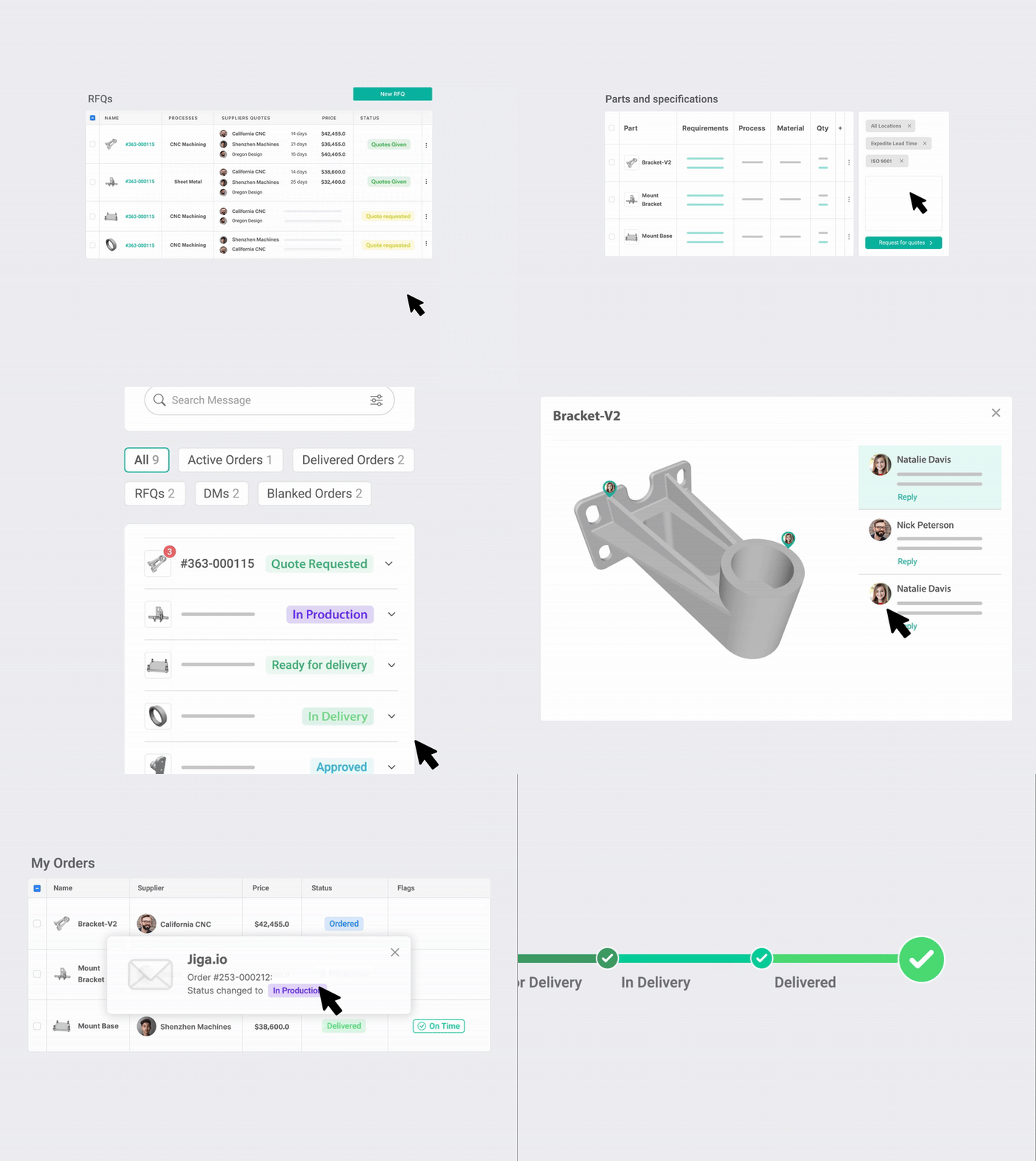
We don’t get credit for sending you unless you use our link.
We know you are probably reading this on your personal email/laptop. Please go to jiga.io/hwh when you get into work. We only take on a couple sponsors and truly appreciate you using our links!
Ok, a couple other quick things:
Chat GPT (Your MBA Wingman)
Leverage ChatGPT as much as possible. Create projects for Finances, Compliance, Corporate Structure, etc. so it remembers your history. Use it to figure out how to start a business bank account, get sales tax exemption, hire people, etc. Pay for the plus account. It is worth it 10X over. Oftentimes when we talk to people about using ChatGPT, they say “it hallucinates,” “it gets things wrong,” “it takes too long.”
A. You might be doing it wrong. It needs as much context on you and what you're doing as possible to be good; provide all that context.
B. It being 80% at anything might seem horrible when you are a subject matter expert (aka in engineering), but one thing we have learned is all those boomer businesses and any other small business is already doing less than 80% at things like law, compliance, and finance. We have been shocked how much better it is than when we pay for those services. And . . . most of the world isn’t 90+% compliant, etc. Welcome to small business. So move fast and leverage ChatGPT. It is one of your biggest advantages as a young small business owner. (Don’t have it do your finances or payroll though; trust and pay for QuickBooks). Move fast and break things!
C. Iterate. One-shotting is a relatively rare event. Sometimes it may take 5-10+ prompts to get desired action on a complex script. Is it frustrating? Yes. Is it 1000X faster than you writing the script from scratch? Yes. I know it takes some of the fun out of engineering, but the 10X speed is worth it.
D. Be wary of rabbit holes. If something seems harder or more complex than it should be, it probably is! Using ChatGPT is not an excuse to turn off your brain. If something doesn’t make sense to you, find out why. The number of simple mistakes you can still find in LLMs is shocking, they are definitely not at the stage where blind trust will work. That said, I have gotten to the stage where if something sounds right to me, I will usually accept it without further proof. Perhaps this means I am creating an echo chamber, but generally speaking first principles can get you pretty far.
Real Estate
You aren’t venture-backed, so you don’t need beautiful offices. Find space on LoopNet that costs $1.25–1.75/sqft and only rent what you need for next 6 months (1–3k feet). If you are spending more than 2X your apartment’s rent, you are renting too much space (or have too many roommates). Expanding is a good thing (you can then afford more space!). Who can. say what your needs will be six months from now, there is no data to extrapolate based off of.
Also, don’t sign a contract for more than 2 years. Brokers will give you an AIR lease. We learned the hard way you basically can’t change it. Maybe if you use a broker of your own and have them negotiate on your behalf, but be prepared for that to waste a TON of time. Instead, focus on any changes the landlord made to the standard boilerplate (typically in red) and any addendums (where they talk parking, signage, noise, etc.). You want a gross lease, not a triple net (NNN) lease (ChatGPT the difference if curious) and we recommend you visit a bunch of places. Shotgun approach here is crucial. You will not know the market or if one place you tour is a good deal or a bad deal unless you see 10+ data points. We were shocked with the wide range of options for the same price (as well as by the responsiveness and availability of leasing agents). The variance was much higher than an apartment. Also, renting from a building that is owned by a person or two is much easier than one owned by a REIT. Ask about this when you visit.

Finally the last thing we learned the hard way is look into the power. It is one thing to have the breaker capacity; it is another thing to have the actual wire run to where it needs to go. If you are going into a product that requires big machines, make sure the power runs exist. It is incredibly expensive to install those later (think potentially a month of rent+).
One underrated item that sometimes gets overlooked: parking. How many employees do you envision having six months from now? Where will they park? This often isn’t a dealbreaker, but it definitely something to watch for.
Also note that the commercial real estate market is cold right now. Luckily, that’s great for you! That means places sitting on the market for months —> more supply, less demand —> desperation —> better prices! For now, YOU are in the drivers seat. Don’t accept getting hardballed and know that negotiations are good! The worst they can say is no.
*An actual photo of our warehouse the day we moved in! Though unorthodox, those red floors have really grown on us (…or at least one of us…).
Machines
Don’t get greedy. It is incredible what people can do. Don’t automate to start; your product will almost certainly change a bunch before you lock in big orders. Use Facebook Marketplace. It is way better than Craigslist these days. Chinese machines are also a possibility. There is a lead time and functionality/service risk, but it might be worth it for a quarter the price (or even less). Often the big American manufacturing companies won’t even sell to you yet because you aren’t big enough. On the other hand, it might make sense to buy the American brand if the machine is the core of the product you are making. Service is highly underrated, being able to talk on the phone to someone that understands what you’re saying without translation and can help fix issues that come up is BIG. This is more and more true the more expensive the machine.
A friend of ours postulated that of all the equipment he’s bought (a lot, trust us), 90% of the time, the amount of time he spends debugging the Chinese machine ends up being about equivalent to if not higher than the extra money that he would have spent on the American machine. Depending on the machine complexity, that’s totally a valid point. For simpler machines, your basic engineering skills should be enough to reasonably quickly fix most problems that crop up.
One of our facebook marketplace finds is a China classic and has broken 3 times in the last two months. However, fixing each break involved:
Recrimping a wired connection correctly
Replacing a terminal block
Replacing a relay
Root causing can sometimes be a difficult and has no exact timeline, but for simple machines, there’s really only a few things that can go wrong, so an approach of isolate components and check if there’s an issue usually works.
Also note that single point of failure = bad. If it can fail and bring your line to a halt, it will. Never underestimate the power of redundancy. By redundancy I mean stocking extras of components after they fail once, not necessarily stocking an entire extra machine… unless it’s justified — we’ve done this with our most critical machines. Having a way to do a method manually as a backup for machine failure is perfect until it goes back online, but if there is no way to manually replicate it, a complete backup might be a good idea (plus if it’s a line bottleneck, then this will expand production — downside is that it’s probably costly).
People
The job market for manual labor is super tough right now, so there is a ton of well-qualified manufacturing labor out there. Spend $45 on a Craigslist ad and then invite the top candidates in for an actual test trial (pay them to actually do the job for a few hours). Pick the best!
Ok, we’ll leave it there for now. Stay tuned for more. Get the wheels turning on what opportunities might exist. Good luck!